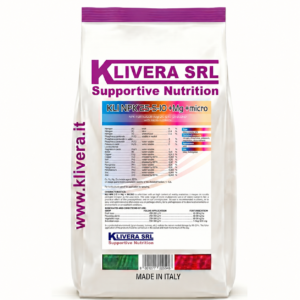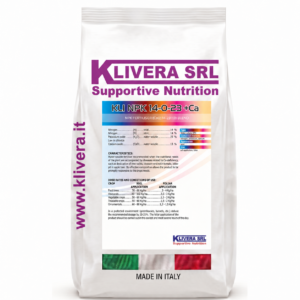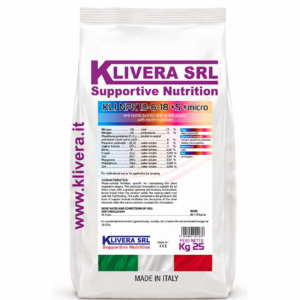
Description
Typology: Water-soluble NPK | Contained elements: Nitrogen, phosphorus, potassium, magnesium, micro-nutrients | Appearance: Solid | Use: Foliar, Fertirrigation
Composition:
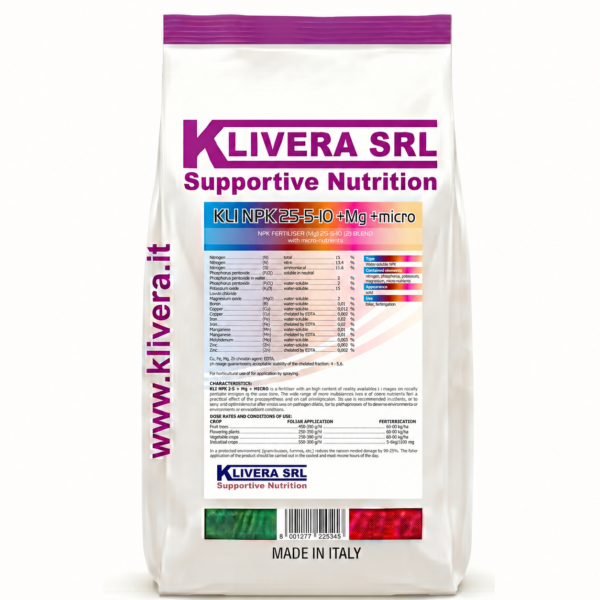
- Nitrogen (N) total: 25% | Nitric: 13.4% | Ammoniacal: 11.6%
- Phosphorus pentoxide (P₂O₅) soluble in neutral ammonium citrate and in water: 5%
- Phosphorus pentoxide (P₂O₅) water-soluble: 5%
- Potassium oxide (K₂O) water-soluble: 10%
- Low in chloride
- Magnesium oxide (MgO) water-soluble: 2%
- Boron (B): 0.01% | Copper (Cu) water-soluble & chelated by EDTA: 0.002% | Iron (Fe) water-soluble & chelated by EDTA: 0.02% | Manganese (Mn) water-soluble & chelated by EDTA: 0.01% | Molybdenum (Mo): 0.001% | Zinc (Zn) water-soluble & chelated by EDTA: 0.002%
- Cu, Fe, Mn, Zn chelating agent: EDTA | pH range for chelate stability: 4–6.5
For horticultural use or for application by spraying.
Characteristics:
Fertiliser with a high content of readily available nitrogen. The wide range of micro-nutrients in chelated form, combined with magnesium, have a beneficial effect on the photosynthesis and on cell multiplication. Its use is recommended from the vegetative re-growth until the fruit ripening, or to carry out rapid treatments after stress due to pathogen attack or to adverse environmental or atmospheric conditions.
Dose Rates and Conditions of Use:
Crop | Foliar Application | Fertirrigation
- Fruit trees: 200–250 g/hl | 60–80 Kg/ha
- Flowering plants: 200–250 g/hl | 60–80 Kg/ha
- Vegetable crops: 250–300 g/hl | 60–80 Kg/ha
- Industrial crops: 250–400 g/hl | 5–8 Kg/1000 mq
In a protected environment reduce the recommended dosage by 20–25%.
Miscibility: The product does not present contraindications for miscibility with other formulations, however it is always advisable to carry out miscibility tests to check compatibility.